Comorbid ME & ADHD: a Living Death
the devastation of having an dopamine starved mind while existing in a body unable to handle most stimuli. mourning what was, holding what is. chronic illness as our bodies’ revolt against capitalism

cw: nondescript mentions of death due to m.e., ableism, and systemic violence
There are no words to describe the devastation of Myalgic Encephalomyelitis. Like many others suffering from this illness, I grieve the loss of my former self entirely.1 Yet, most coping mechanisms risk worsening my baseline. And all my needs are now too far out of reach. Even sitting up in bed has violent repercussions.
Meet the systemic neuroimmune marker of this condition, post exertional malaise, used to define an exacerbation of symptoms following even minimal cognitive, emotional, and physical exertion. Unlike traditional “fatigue,” PEM impairs your previous level of functioning, bearing consequences disproportionate to your level of activity. As a result, ME in its mildest form causes a 50% reduction in functional capacity.
The symptoms triggered by PEM are countless, but can include full body pain, profound fatigue, brain fog, paralysis, seizures, flu-like symptoms, weakness, feverishness, disorientation, migraines, and the inability to chew or swallow. More examples of additional symptoms are linked here. This typically occurs 12-48 hours after exertion but can last for hours, to days, to weeks at a time (please note: these symptoms vary person by person, and also depends on the severity of your ME — “mild” ME can present in a far more subtle nature, such as concentration difficulty, memory problems, muscle aches, and lightheadedness following exertion. Identifying this illness in its early stages, when possible, benefits our overall health outcomes).
Many of us with severe2 Myalgic Encephalomyelitis are bedbound, stripped of our ability to move, speak, or think, and unable to handle most stimuli, in which even light, sound, or touch can result in PEM. Those with very severe ME are often fully dependent on hospital’s to survive, reliant on IV-fluids and feeding tubes, and 24/7 darkness and silence.
Yet, under racial capitalism, accessing this level of care is an impossibility for most, disproportionately those of the global majority. The lack of medical awareness surrounding ME, compounded by ableism and sanism (which both have their roots in anti-Blackness), has led to people with very severe ME being “turned away from homeless shelters, locked up in psych wards, and (many more) dying of starvation for lack of feeding tubes.” Every disabled person killed is the loss of an entire universe.
Alongside autonomic, metabolic, immunologic, neurologic, cardiovascular, gastrointestinal, musculoskeletal, and hypothalamus-pituitary-adrenal axis impairments, those with ME are essentially living with an altered, potentially broken, mitochondria.
The very nature of this condition makes it impossible to “push through symptoms” in which overexertion or lack of care (by personal / environmental factors) lowers our overall baseline and can lead to death.
PEM is traumatic, to say the least. Even more so for Black and brown femmes, whose access to autonomy and rest has been additionally constrained by systemic violence. The overepresentation of white people in the ME “community” is no doubt informed by medical racism, misogyny, and classism, which deprives those marginalized by race, gender, and class from accessing the care needed to survive this illness, or receive a formal diagnosis, leading to far more fatal health outcomes.
While there are no current treatments for PEM, managing this chronic illness requires pacing and “rest” (I put rest in quotes, because rest becomes survival with ME, and is often far from restful).
To no fault of their own, individuals whose circumstances cannot account for these needs, risk developing a lower baseline: chronic stress from the trauma of living in a postcolonial society poses potentially deadly consequences for multi-marginalized people with ME, as a taxing form of cognitive, emotional, and physical exertion capable of triggering rolling PEM.
I know this to be true, because I’ve lived this. As someone who developed ME due to gendered racial trauma, my own body is a citation. Stress remains one of my most pervasive triggers. The cycle is vicious.
We must consider how these material realities impact our Black and brown disabled and pre-disabled comrades, especially those who are working-class, femme, unhoused, or incarcerated (for whom access to rest is all the more limited).3 Disability justice is a praxis that answers to the needs of Black, Indigenous, people of color throughout the globe, honoring their survival wisdom and ancestral knowledge, as we co-create a culture rooted in collective care.
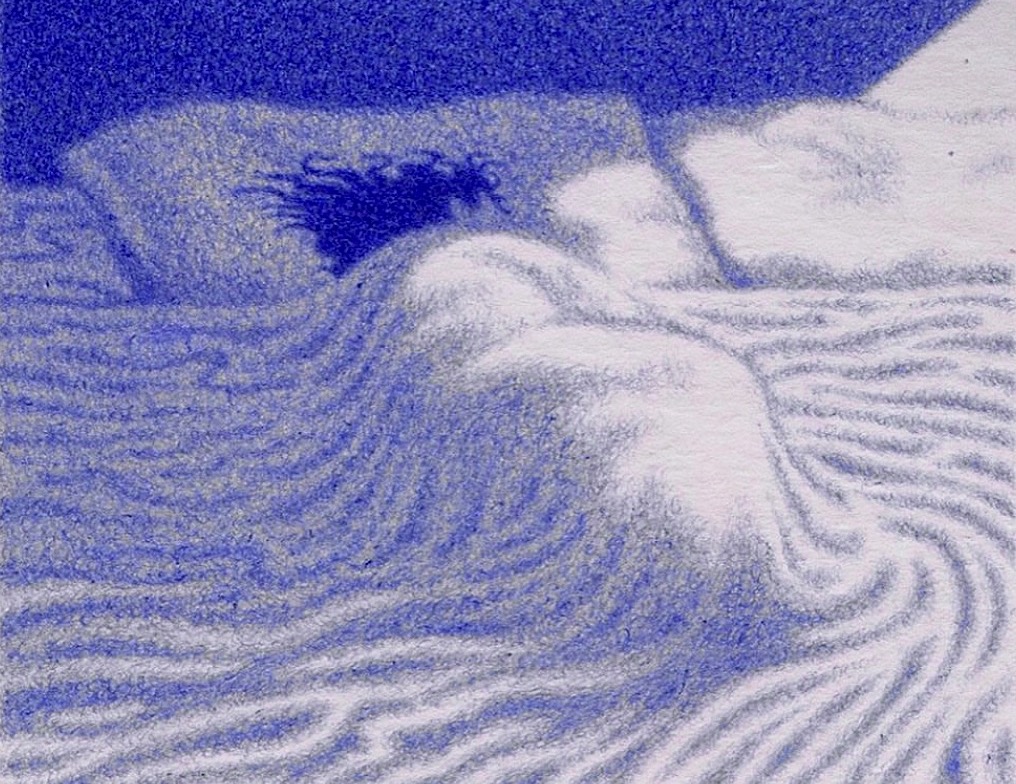
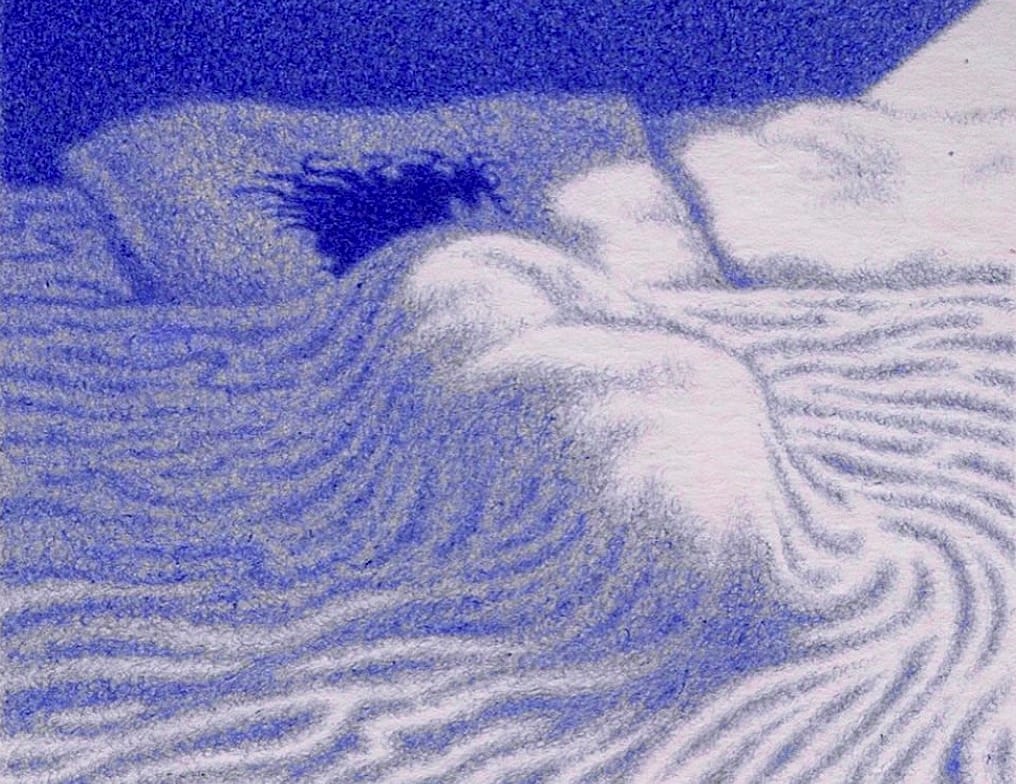
art by dadu (2023), dadushin on insta. a blue ballpoint pen drawing on white paper of a person with long hair in bed, with the bedsheets swirling
Although surviving ME is a brutal struggle in and of itself, like many others who suffer from this illness, I also have ADHD. Meaning, on top of unending pain and fatigue (insert your symptoms here), we live with a brain starved of dopamine, despite existing in a body unable to handle most stimuli.
Before developing ME, my mind moved a hundred miles per minute, and following each thread brought me boundless joy. Whether I was talking with a stranger, immersed in my latest research project, climbing the tallest trees, or getting lost in a new book, devotion and curiosity was my heart’s way. I was never sitting still and had an imagination that could keep me entertained for hours. AuDHD informed every aspect of my identity, and my entire relationship with grief, care, and pleasure, which I felt viscerally.
While I remember very little of my home life due to trauma, most of my childhood memories are of the land, and the ocean.
Almost every day after work and classes, I took myself hiking — to the trees and mountains who raised me. Their company was the only place I felt I could truly unmask, where I could sing, dance, and stim freely, processing grief that was unsafe for me to express elsewhere.
I left offerings for the earth. Nearly all the old notes of mine read some variation of the same words: IT’S A NEVER ENDING LOVE LETTER TO THE SUN. The sun was my altar, my muse, and my teacher. Their embrace held me like no other.
My body was a prayer only they could reach.
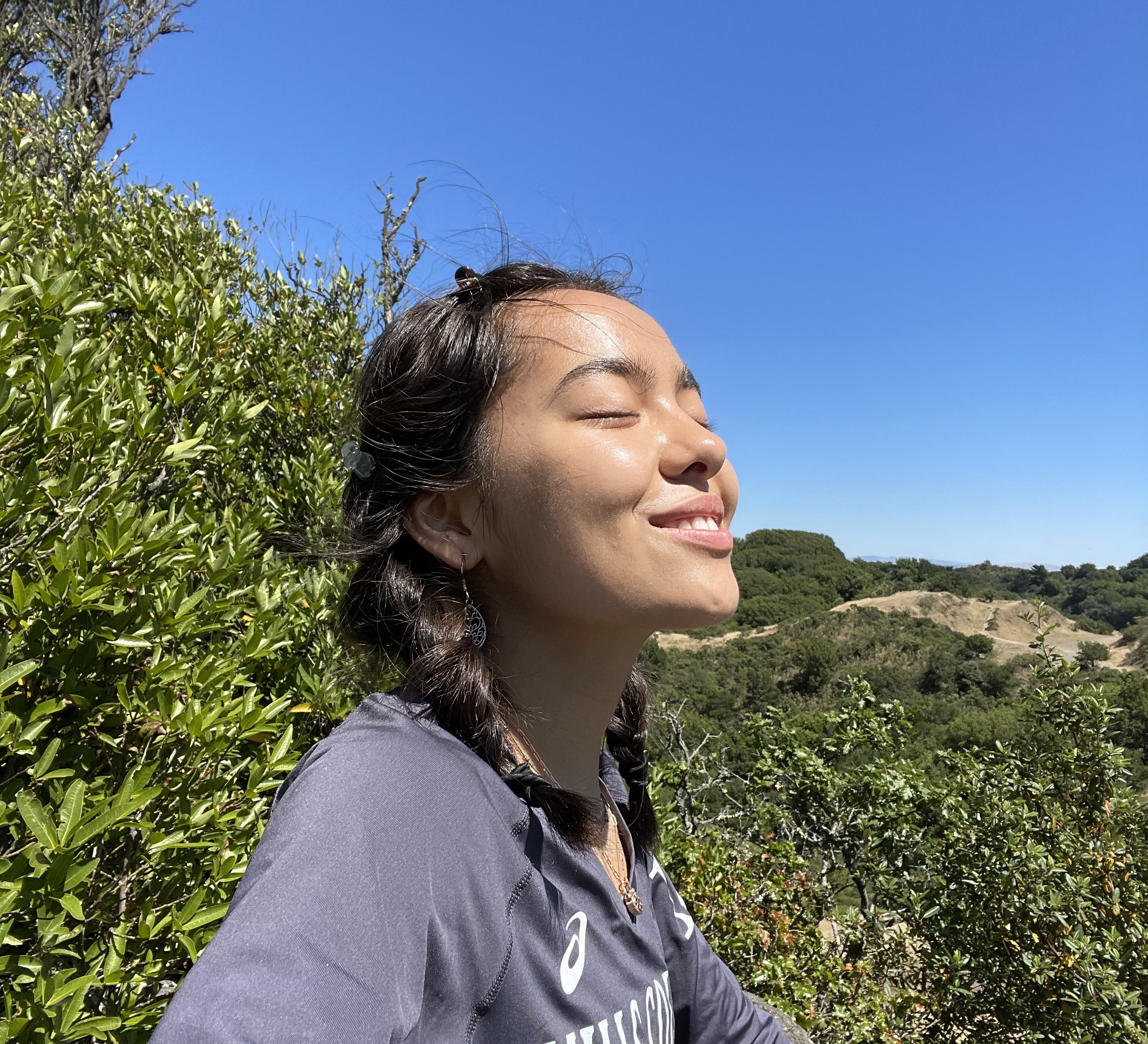
photo of me (a chinesewhite femme with my hair in two braids) talking to the sun, and soaking in her light with a smile and my eyes closed. i’m sitting on the edge of a tree covered mountain and the sky is blue. i still remember this day so clearly ⋆ 𖤓 ⋆˚࿔⁺₊⋆ ☀︎ ⋆⁺₊
Even when trauma and autistic burnout led to me preferring time alone, and avoiding other people, I continued to find endless company in the land.
I swam so much, it bleached the bottom four inches of my dark brown hair.
Learning to read the waves called me back to my body which I spent my life escaping to survive abuse. It is in this way, surfing returned me to myself, grounding me in my senses and intuition. In the arms of the ocean, I was protected. To be carried by a wave was a tender union. At the beach, I felt alive again, born anew.
I was lucky enough to be a surfing mentor for several years, which allowed me to share this joy with others.

photo of me (a chinesewhite femme with my hair in a bun) smiling at the beach towards the water with one of surfing mentees, wearing a black wetsuit and a pink shirt ⋆𓇼。𖦹˙༄.°
Growing up, baking for my friends was another sacred ritual. These moments always felt intimate to me. I have very few photos of what was actually made.
Sifting my hands through soft flour, kneading the dough until it was flaky and wet, the smell of vanilla rich in the air — you could taste the joy.
This was always an elaborate dance between tasks, peeling seeds from stem, straining custard, whisking spices, baking the crust until was juuuust golden brown enough. Everything had to be from scratch. My baking almost never went according to plan, but for that reason precisely, it felt like love, like loving.
Offering my hands to food was as much as spiritual exchange as it was an ode to my friends (my sun sign is taurus, hehe).
I miss baking for my loved ones and nourishing my community. I miss the feeling of wind on my skin. I miss touching the earth, seeing the sky, and being held by the sun. I wish I took more photos when I had the chance.

collage of some desserts i’ve made for loved ones throughout the years (fruit tarts with strawberries, blackberries, raspberries, and mango, carrot cake with cream cheese frosting and crushed walnuts, dutch baby with powdered sugar, whipped cream, and raspberries) ‧₊˚❀༉‧₊˚.
Symptoms like PEM deal a particularly devastating blow to our ability to acess community or basic joys (let alone survive under capitalism, or manage our day-to-day lives). Many of us with severe ME are bedbound with 24/7 symptoms, unable to handle most stimuli, and can only minimally talk and move, if at all.4
In addition to being fully bedbound (besides occasional bathroom use), I’m reliant on full time caregiving support to meet my basic needs. Every minute of my day is spent suffering in a darkened room,5 navigating hospital level pain and unending symptoms of the daily. I go months at a time unable to handle any sunlight, music, reading, the tasks needed to care for myself, or the company of friends, in which all I can do to pass the time is close my eyes, or stare at the ceiling, with shaky vision. Even being pushed in a wheelchair is often an impossibility, and always worsens my baseline. The friction of living in a body that’s unable to meet the needs of my ADHD (or my human need for connection) leaves me feeling like I could implode at any given time.
It is agonizing to experiencing unending symptoms, while also being deprived of the ability to cope, in which even thinking or feeling can trigger PEM. The tumultuous ups and downs of this chronic illness are particularly traumatizing, and even moments of “higher” capacity are burdened by constant threat of further decline.
Scattered throughout my room are piles of pill bottles. I’ve been prescribed over nine medications to help me maintain my (already low) baseline. I share this to name how challenging it would be to survive ME without the proper medical care or support.
If there is one thing pre-disabled people should take from this essay it is this: A few hours experiencing the daily lives of those with ME would send most people to the ER or into a crisis state. We need your advocacy and support while we are still alive, however you have the means or capacity.6
To other people with ME: Although I can never fully understand the extent of your experiences, I want to acknowledge how hard you’re trying to survive. You deserve immense care and tenderness, accommodation and understanding, to be held, heard, and believed— this should not have to be a fight you face alone. You’re navigating a living death, finding new ways to maintain yourself despite brutal circumstances. Please know, you do so much. You’ve had to learn to be a full time caregiver, advocate, and innovator, with little to no reprieve. There is nothing shameful about your pain. The grief is insurmountable. You are allowed to be angry. The wisdom innate to your survival carries the collective forward, including the versions of you that were failed. Our existence is further proof that life beyond this (white) capitalist, colonial society is not only possible, but expansive. May we build a new world where no one is expendable, and our younger and present selves are held, and protected in the ways we’ve long deserved.
While research has yet to catch up to our experiences, the quality of life of severe ME patients has scored on the EQ-5D-3L scale as 15 times worse than cancer. Other studies have found that the daily QOL of severe ME patients is comparable to chemotherapy patients and AIDS patients in their final weeks of life. Those with very severe ME are some of the sickest people on earth. Despite this, their experiences often go underrepresented in research due to being unable to handle any communication with the outside world.
As people with ME, it is easy to think of PEM as a punishment because of how brutally it dictates our day-to-day lives.
- We deserve to conceptualize our reality however is most supportive to our experience of this devastating illness.
- One framing I found personally helpful was shared by Sammy (an advocate with severe ME who has since passed): while “the exact cause of PEM is unknown…the symptoms of PEM seem to serve an important function in the body of ME patients as it is essentially a way of saving energy during energy deficiencies. Paralysis, extreme exhaustion, pain, light sensitivity, all these symptoms keep patients in bed and unable to expend large amounts of energy at a time when the body’s energy symptoms are failing. So well PEM can be incredibly frustrating and feel like a punishment, it is quite possible that without PEM, ME would be a much more deadly disease.” Her post can be found here.
I’m extremely fortunate to currently have access to caregiving support from a family member. Learning to accept help and not push myself past my new baseline has made a huge difference in my overall functioning. Lately, this has meant allowing myself to stay in bed to manage my debilitating chronic pain, fatigue, and sensory sensitivity (etc.) even when I think I can “do more” — because as I’ve learned from my PEM, this always catches up to me in the form of further disablement.
While my PEM used to include falling into a feverish sleep without choice, extreme disorientation, pain, flu symptoms, brain fog, sweats that would wet my bed in their entirety, nightmares and hallucinations, paralysis, extreme sensitivity to sounds, smells, and light, migraines, the inability to chew, and swallow, or use the bathroom — honoring my new baseline has led to my experience of PEM being far less violent in which I still tend to fall asleep without choice, but haven’t experienced paralysis, sweats, or the inability to chew and swallow in over a month.
The reality is, most people are not afforded the privilege (*right) of full time care, or even rest under empire and racial capitalism. Black and brown people, especially those who are working-class and femme, are disproportionately at risk of very severe ME and death for these reasons precisely. To matter, ME advocacy must center racial justice, gender liberation, and class struggle. Otherwise, our “world-building” will only continue to exploit, harm, and marginalize our Black and brown comrades, whose wellbeing defines the conditions of our collective liberation. Disability is a social identity informed by systemic violence. Black and Indigenous peoples continue to maintain the ancestral wisdom and material struggle needed to holistically support those experiencing pain and distress. To cite Trey Washington , in their essay Rest is Not Resistance, and That is OK: On Cancer, Grief, & Audre Lorde, “what my body-mind truly needs is the fall of the empire.” It is imperative that our collective organizing can account for these truths.7
I believe our bodies know that we are worthy of care and protection: this understanding has changed my conceptualization of PEM entirely, in which I no longer view it as a punishment, but rather my body’s strongest line of defense against an absolutely brutal illness that is caused and exacerbated by the acute trauma and stress of living in a postcolonial society.
When I say “body” is it always with the understanding that our bodymindspirit are interconnected. Mad liberation reminds us that colonialism, white supremacy, anti-Blackness, and racial capitalism plague our bodies and the land, while pathologizing our justified responses and adaptions to these social conditions.
Yet, we continue to love, fight, grieve, heal, and resist. This is what it means to be unwell in a sick society.
Chronic illness is an embodied protest against the institutionalized violence that informs our day-to-day lives. Settler colonialism and racial capitalism enforce a border between our physical, emotional, and spiritual self in an attempt to exploit our bodies, as a resource for extraction — disproportionately along the lines of race, gender, and class. Our bodies carry the knowledge that this is not how we are meant to live, demanding the tenderness and rest we deserve in the form of pain, distress, and disablement.
Those of us forced into the margins of society continue to alchemize, invent, and forge new ways of being, rooted in our interrelatedness, expanding upon the infrastructure built by our ill forbearers.
The wisdom we inherit from our disabled bodies and ancestors water the seeds of our collective liberation, providing us with a gateway towards abundant futures, where all our needs can be met.
💌🌱🌱 for those who would like to support me monetarily, my v 3 n m 0 & c a s h a p p are solenneh. as a severely disabled femme who is otherwise unable to work, all fun/dz will go towards compensating my caregivers. thank you dearly
Being disabled tells you nothing about someone’s quality of life. This is often instead informed by our material circumstances, and the systemic violence, ableism, neglect, disposability, and abandonment disabled people face in our society. Disability is a social identity. I would still choose to have Autism and ADHD in every life. In the words of Trey Washington, from their essay Rest is Not Resistance and That is OK: On Cancer, Grief, & Audre Lorde, “what my body-mind needs is the fall of empire” ↩
I would like to add that distinctions between “moderate” and “severe” are often medical pathologies defined along colonial, capitalistic standards that don’t reflect the lived experiences of those navigating chronic illness. I hope to write about this more in depth soon ↩
Working-class people, disproportionately those who are Black and brown / exploited by racial capitalism, often face unrelenting labor demands which makes surviving ME all the more challenging. Mutual a!d is needed to support our those who are chronically ill and multiply-marginalized, alongside organizing against systemic violence, for our collective liberation ↩
Because ME is a spectrum, some people with severe ME may be able to use the bathroom on their own, others may not. Some people with severe ME can read a few pages of text, others cannot. Some people with severe ME can stand to open their blinds, others cannot. Some people with severe ME can watch a movie, others cannot. Some people with severe ME can tolerate light, others must remain in complete darkness to manage their symptoms. For someone with very severe ME, even coughing can be enough to trigger PEM. All of these factors can also change day by day, month by month, and year by year ↩
While staying in a dark and quiet room is often needed for the survival of those with severe ME, those who do not have access to these resources are likely to be pushed towards further decline, and even death. This is why ME advocacy must center racial justice, gender liberation, and class struggle. Black and brown people, especially those who are working-class and femme, are disproportionately likely to be deprived access to these survival needs by way of systemic violence ↩
This link provides a list of over 50 ways to support people with ME. For those who have the means or capacity, helping with daily tasks, contributing to people mutual a!d campaigns, or research funding makes a big difference. Raising awareness online and in-person about this illness is also vital. Most of the advocacy for ME is done by people who have ME themselves, whose capacity is already severely limited by this illness. Accomplices are needed ↩
It is the collective responsibility of white comrades and pre-disabled comrades of color — especially those privileged by their class positionality — to offer care and practice taking on tangible labor that enables Black and brown femmes to access healing, rest, and support (via labor redistribution, compensation, care work, etc. — with more examples linked here) ↩