Our Organizing Must Honor the Survival Wisdom of Black and Brown Disabled Femmes
ending the exploitation of black & brown femmes in our organizing “spaces.” how neglecting the disability justice reproduces white supremacy, misogyny, & classism

(cw: nondescript mentions of death due to systemic violence. descriptions of exploitation along the lines of race, gender, and class leading to disability, further disablement, & death. i share this as an invitation to hold yourself and check in with any emotions that come up, whether that be with a deep breath, a pause, or any other forms of care that may be accessible. your wellbeing means a great deal to me. you deserve tenderness & grace)
Whether by aging, an illness or an accident, every person will either become disabled or is born disabled. And despite what ableism and whitewashing would have you believe, disability is a social identity directly informed by the material realities.
Existing at the intersection of anti-Blackness, white supremacy, colonialism, racial capitalism, classism, misogynoir, misogyny, environmental and medical racism, Black and brown femmes face extreme rates of exploitation, wage theft, burnout, sexual violence, houselessness, and incarceration, which includes being most likely to be exposed to pollutants and viruses, in addition to being most likely to be denied medical care, material and emotional support. Structural demands (which also inform interpersonal dynamics) additionally deprive Black and brown femmes of autonomy and rest. All these factors combined, lead to chronic stress, and trauma, which contributes directly to health issues (or vice versa) that are often neglected, pathologized, criminalized, and misdiagnosed by our current colonial healthcare models.
As a result, Black and brown working class femmes (especially those who are unhoused, queer/trans, incarcerated formerly incarcerated, or actively resisting genocide) are disabled at disproportionate rates and made far more likely to die from ableism than their counterparts.
Given the disabled community is mostly Black and brown working class femmes who have been neglected by the world and their comrades alike — just surviving their day-to-day requires militancy and the creation of their own lifeways, strategies, and community. It is critical that our organizing honors this survival wisdom,1 acknowledges the lineages of these practices, and compensates Black and brown disabled femmes for their labor, while also dismantling the structural violence that has forced our comrades to develop these tools to survive. Neglecting to do so only reinforces the very violence we claim to be against by further exploiting Black and brown femmes, co-opting their knowledge, and pushing them closer to death.
Alongside the efforts of Black and brown disabled femmes to maintain their ancestral practices and traditions, as well as care for their people and the land — many Black and brown disabled femmes have been forced to learn numerous forms of carework and advocacy for their own survival and the survival of those in their community. This includes, but is not limited to, embodying collective care, organizing mutual aid campaigns, resource re/distribution, maintaining ancestral knowledge, providing medicine work, herbal treatments, tinctures, political education, and spiritual nourishment, emotional labor, creating a space for their comrades to experience healing, rest, and care, holding others and themselves accountable, naming and addressing harm, assessing their personal capacity, tending to the capacity of their comrades (which, in the long-term prevents burnout and death), radical and collective self care, maintaining oral histories, facilitating grief work, somatic liberation, political writing and art, unsettling standards of urgency and perfectionism (reinforced by colonialism and white supremacy), masking to protect themselves and others from the devastating and deadly consequences of Covid-19, other viruses, pollution, and state surveillance, strategically assessing if and when they can/cannot offer a physical presence on the frontlines, practicing restorative, and transformative justice, as well as modeling non-hierarchical leadership through shared decision making that decenter’s the ego and honors the collective: it is the implementation of these practices that sustain all long-term movement building.
However, because the exploitation of Black and brown femmes has been normalized, and most of what I described are historically racialized and feminized forms of labor — that disabled people of color are often forced to learn first — they tend to be undercompensated and underreciprocated in organizing “spaces.” This leaves Black and brown femmes with far too much demanded of them and little emotional and structural support to fall back on themselves. It is in this way that even so-called liberatory “collectives” often fail their Black and brown femme comrades — reproducing the neglect they experience in broader society that puts them at greater risk of experiencing disability and death, while the labor Black and brown femmes expend helps prevent their comrades from experiencing the same.
Disability justice has been predominantly defined by Black and brown disabled femmes in their material struggle against systemic violence. And it is only with an intentional implementation of these principles and practices that our comrades and our movements will survive.
Far too often I’ve witnessed the wisdom of Black and brown disabled femmes be disregarded, only for this to catch up to organizers in the form of preventable burnout, disablement, trauma, and harm — enough to bring entire collectives to an end. If these issues are even addressed thereafter, it is usually a hasty attempt to implement the practices and infrastructure built by Black and brown disabled femmes. This only inflicts further violence as an act of co-optation that ultimately extracts labor from our comrades while disingenuously mimicking the values that inform these politics.
If our organizing neglects to intentionally honor the survival wisdom of Black and brown disabled femmes, we participate in their exploitation, erasure, and eradication by carrying these violences into the “liberated” future we’re supposedly fighting for.
Honoring the survival wisdom embodied by Black and brown disabled femmes includes:
recognizing and disrupting the violent circumstances Black and brown femmes have been forced to navigate for the sake of their survival
compensating Black and brown disabled femmes for their labor, especially emotional labor, which is too often invisibilized
dismantling the labor imbalances that are structurally reinforced against Black and brown disabled femmes along the lines of white supremacy, colonialism, anti-Blackness, classism, misogynoir, and misogyny
it is the collective responsibility of white comrades and pre-disabled comrades of color — especially those privileged by their class positionality — to offer care and practice taking on tangible labor that enables Black and brown femmes to access healing, rest, and support
adopting and building wider networks of support within organizing collectives that honor the wisdom, practices, and infrastructure that Black and brown disabled femmes have created (/build wider networks of support within our organizing collectives that ensure everyone’s emotional and material needs are being met, beginning with our most marginalized comrades)
This is how we keep our movements alive
I am acutely aware of the long-term impact of organizing on our nervous systems, especially when labor imbalances along the lines of race and gender remain unsettled — a truth that the women of the Black Panther Party understood intimately when they called for radical and collective self-care.
Everything I write in this essay, I have both experienced and observed in organizing spaces to varying degrees. However, as someone privileged by my proximity to whiteness (and the access to healthcare and material support this has afforded me), our experiences themselves cannot be equated. What is neglected in most of our movements, is the voices of Black and brown disabled femmes.
Had pre-disabled people listened to the guidance and warnings from Black and brown disabled femmes these past few decades — better yet, cared about their suffering — none of the “recent developments” of fascism in amerika would be surprising as the lived experiences of disabled people of color foreshadowed these events for years. While a commitment to the wellbeing and wisdom of Black and brown disabled femmes would have inadvertently better prepared the collective for our current political landscape,
It is not the responsibility of Black and brown disabled femmes to be our teachers, and they deserve to be loved into with the steadfast commitment they have to their people. Yet, they remain exploited in even most spaces supposedly organizing for our collective liberation — disabled or further disabled by the disproportionate amounts of trauma and labor they’re subjected to by their comrades and society alike. Where is their reprieve? Their place of rest? Their protection? I am sick of watching my Black and brown disabled comrades die from neglect and stress, all of which could be prevented if their own care was reflected back to them in advocacy and labor redistribution, checks-ins, presence, compensation, masking, ongoing dialogues on accessibility, emotional and material support. I know liberatory love exists because I have seen and felt it from my Black and brown disabled comrades.
The revolution will be accessible so our organizing must also embody this truth.
Asking anonymously about people’s needs when coordinating a meeting amongst organizers is necessary starting point. Many Black and brown disabled femmes continue to provide support, advocacy, and labor from their homes, encampments, and sickbeds that we have a collective responsibility to honor, compensate, and implement in our daily lives.
They’ve already shown us the way forward. We must remember the Black and brown femmes who are also too disabled to continue organizing because of the acute violence and exploitation they’ve experienced from society and so-called “comrades” alike.
As it has been said by many others before me in many different words, all disabled people of color are organizers because we have had to learn to be full time advocates and caregivers of ourselves to simply survive our day-to-day lives.
As the most marginalized people in our society, Black and brown disabled femmes continue to subvert their survival into a force of liberation. It is their ancestral lifeways, infrastructure, and survival wisdom which teaches us how to better care for and sustain ourselves, our comrades, and our movements.
In the words of Fannie Lou Hamer, world builder, working-class organizer, and leader of the Civil Rights Movement — disabled first by polio in childhood and later by the violence she experienced as a Black woman living in Mississippi:
“nobody’s free, until everybody’s free.”
We will only ever know freedom when every Black and brown disabled femme is free. It is their resistance and knowledge that guides us — their livelihood and wellbeing that defines the conditions of our collective liberation.
Below are just some of many Black and brown disabled organizers and disabled organizers of color whose work has impacted me that I encourage you to explore and compensate however you’re able - please feel free to share the names of more people/your accounts (& preferred means of payment) in the comments:
- Lily Orion on Substack, (lookitslilyo) on Insta
- The Fairy Godfemme on Substack, (thefairygodfemme) on Insta
- Dr.Zaynab, (djinnofthedamned) on Insta
- Devi, the chthonic companion (the.chthonic.companion) on Insta
- on Substack, Amaranthia & Claire (sistacreativesrising) on Insta
- Rise, (riotous_roots on Insta)
- Riz, (yarn_against_the_machine) on Insta
- Cripple Notions: Panteha Abareshi on Substack, (pantehart) on Insta
- Thai Lu (littleom) on Insta
- Octavia’s Chariot (octavias_chariot) on Insta
- I included Imani Barbarin in this list because her videos with captions are a good starting point to learn about the racialized/gendered/classes realities of disability. In the same breath, I also want to be vigilant about rejecting the ways liberalism is reproduced in our organizing
- Alice Wong was later added to this list because her writing on disabled world-building aligns with the contents of this piece. However, I was recently informed of her anti-Black reformism (which you can read more about here). In addition to reformism being antithetical to my politics, liberalism exists at the expense of my Black and brown comrades whose material needs and realities are meant to be prioritized in this essay
- I name this instead of erasing any mention of Imani Barbarin and Alice Wong, because I believe in a building a collective culture of accountability that rejects disposability, honors change, and acknowledges harm in order to heal from it, while prioritizing the needs and critiques of those most impacted
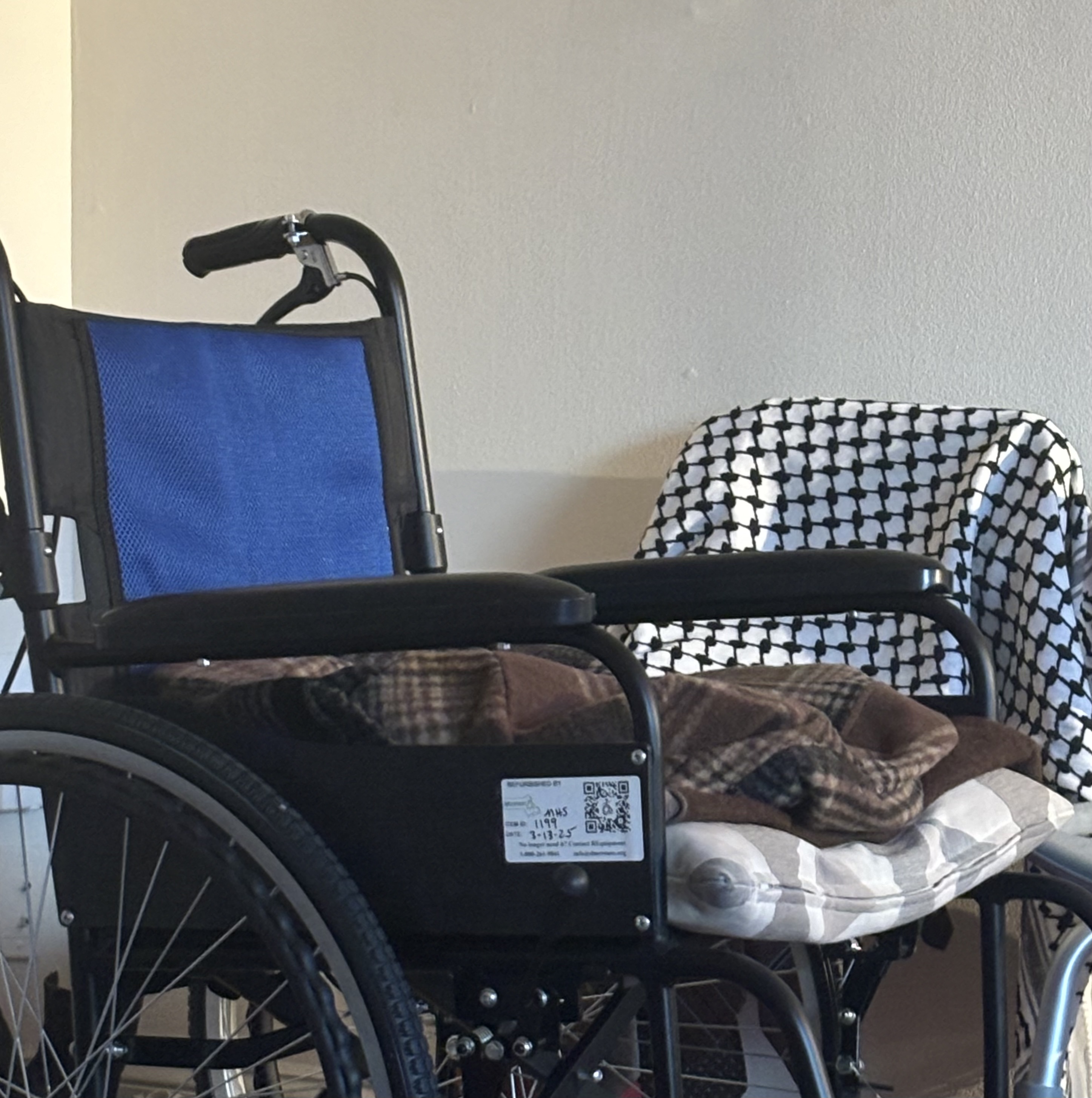
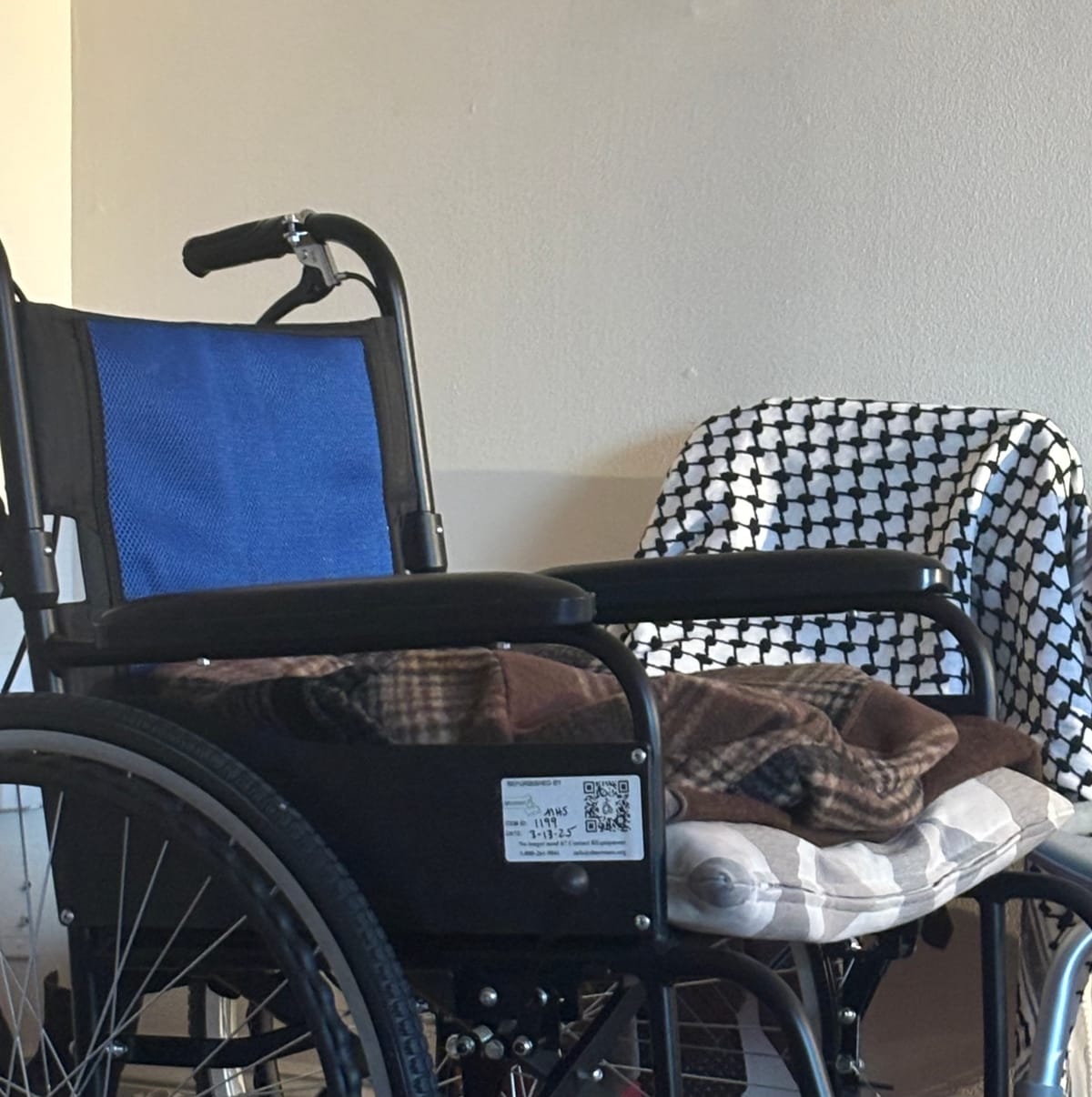
image of a black wheelchair with a grey pillow and a blue padded back, next to chair with a black and white keffiyeh draped on it
In this essay, I define “survival wisdom” as all the practices maintained by Black and brown disabled femmes for their survival, healing, and wellbeing, including the survival, healing and wellbeing of their communities. The practices that emerge from these lineages of knowledge sustain all long-term movement building, whether this is known to us or not.
However, it is vital that we recognize why this wisdom exists in the first place and mobilize against these circumstances. If we neglect to build our movements around the survival wisdom of Black and brown disabled femmes — if we neglect to compensate Black and brown femmes for their labor or fail to disrupt the labor imbalances imposed upon our comrades — we will only reproduce the very violence we claim to be against (white supremacy, anti-Blackness, colonialism, capitalism, classism, misogynoir, misogyny, ableism…further elaboration is provided in this essay) ↩